

Artificial intelligence is changing our world, but not everyone has access to it. Some groups are left behind, facing a big skills gap. This gap makes them less ready for the future of work, showing the need to tackle ai barriers and artificial intelligence obstacles.
McKinsey says AI could add $13 trillion to the global economy by 2030. Yet, 63% of companies haven’t fully used AI in their work.
It’s vital to understand the challenges of ai barriers and artificial intelligence obstacles. They stop companies from using AI’s full potential. Budget issues are a big problem, with 41% of leaders saying it’s their main challenge.
As I explore AI, I aim to find ways to make it accessible to all. This will help everyone benefit from AI’s power.
Key Takeaways
- AI adoption can boost global economic output by $13 trillion by 2030
- 63% of companies haven’t fully integrated AI into their operations
- Addressing ai barriers and artificial intelligence obstacles is crucial for widespread adoption
- 41% of executives cite budget restrictions as their primary obstacle to AI adoption
- AI education can empower underserved communities and bridge the gap to the digital future
- Only 21% of employees are confident in their data literacy skills, indicating a significant knowledge gap
My Journey in Understanding AI’s Accessibility Challenge
Looking back, my first experiences with AI were filled with misconceptions. I had to learn a lot to see how AI can help everyone. It showed me how AI can make learning easier for all.
One big hurdle was finding AI that worked for people with different disabilities. But, I found out that new methods can help. For example, making fake data can improve tools for the deafblind.
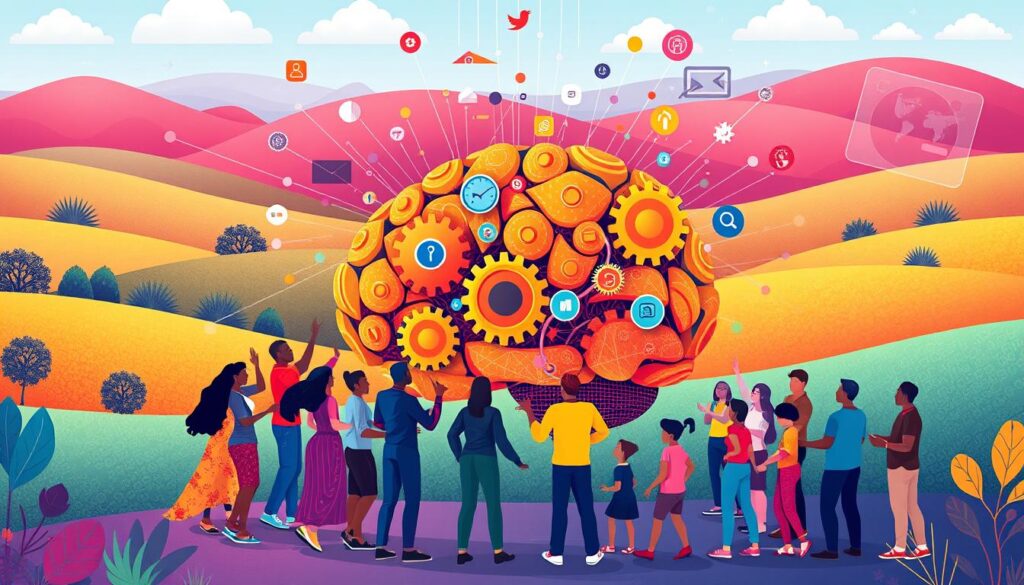
Overcoming AI barriers means tackling several issues. We need more diverse data and affordable technology. This way, AI can help everyone, not just some.
My journey has shown me the importance of understanding AI’s challenges. We must work together to make AI accessible to all. This way, AI can truly help everyone.
The Real AI Barriers We Need to Address
Exploring artificial intelligence reveals many challenges. The cost of education, access to tech, and feeling overwhelmed are big hurdles. Studies found about 18 different barriers to AI adoption.
Telemedicine and AI in healthcare show the need for clear financial support. But, there’s confusion about how to pay for AI tech. Also, setting up and storing data is expensive and complex for healthcare.

To tackle these issues, we must find ways to be more open, test AI well, and follow new rules. This will help AI reach its full potential and change industries for the better.
Effective implementation of AI requires strategic actions, including system integration solutions, ethical guidelines, and ongoing education. By prioritizing these aspects, we can unlock the full potential of AI and create a more inclusive and accessible environment for all.
Why Technical Expertise Shouldn’t Be a Gatekeeping Factor
Exploring AI, I see that knowing how to code shouldn’t stop people from joining in. It’s key to make AI easy for everyone to use. This is where the idea of ai adoption hurdles comes in, showing the obstacles to using AI.
No-code solutions are vital in making AI easier to use. They let people make AI tools without needing to know how to code. Studies show that no-code tools can help overcome many ai adoption hurdles, making AI more accessible.
By making AI tools easy to use, we can help more people use AI, no matter their background. This helps solve the ai adoption hurdles that have slowed AI’s growth. As we explore AI’s limits, making it accessible and inclusive is crucial. We want everyone to be able to use these new technologies.
Democratizing AI Access
Making AI accessible is key to overcoming adoption hurdles. By making AI easier to use, we can unlock its full potential. This means working hard to make AI tools easy to use, offering no-code solutions, and providing training and support.
Building User-Friendly Interfaces
Creating easy-to-use AI interfaces is crucial. We need interfaces that are simple and don’t require a lot of technical knowledge. This makes AI more accessible and helps people use it without barriers.
The Role of No-Code Solutions
No-code solutions are essential for making AI accessible. They let users make AI tools without needing to code. This reduces the hurdles to using AI, making it easier for people and organizations to use AI’s power.
Cost Considerations in AI Implementation
Exploring AI development, I find it’s filled with big challenges. One major one is the cost. Building a complex AI system can be very expensive. Prices vary from $25 a month for simple services to millions for advanced ones.
The cost isn’t just in the tech. It also includes the price of skilled people. In the U.S., a Data Scientist earns about $123,775 on average. A Machine Learning Engineer can make up to $161,590. These salaries quickly increase the overall cost, making AI hard for businesses to adopt.
Still, many companies are moving forward with AI. But, 29% of them say money is the biggest reason they can’t use AI in 2024. To get past this, businesses need to think carefully about their AI plans. They should look for ways to save money.
By understanding the cost considerations in AI implementation, businesses can make informed decisions about their AI development strategies and overcome the significant ai development challenges that come with it.
Breaking the Knowledge Gap: From Complex to Comprehensible
To overcome the barriers to AI integration, we need to make technical concepts simple. Providing resources for self-paced learning helps individuals understand AI. This makes AI more accessible, empowering users to enjoy its benefits like better productivity and decision-making.
Many people don’t know how AI works. To fix this, we need educational resources that explain AI clearly. Online courses, tutorials, and workshops can help. They should fit different learning styles and levels of expertise.
Creating a support community is key to helping users with AI. Online forums, social media groups, and local meetups are great for this. They let users share experiences, ask questions, and learn from others. This builds a network that supports and motivates each other.
Simplifying Technical Concepts
Making technical concepts simple is crucial for AI accessibility. We should use clear language, avoid jargon, and use visuals. This creates an inclusive environment where users feel encouraged to explore AI’s potential.
Resources for Self-Paced Learning
Offering resources for self-paced learning is vital. Online courses, tutorials, and workshops are great for this. They allow users to learn at their own pace, fitting their needs and preferences.
Building a Support Community
Building a support community is essential for AI adoption. Online forums, social media groups, and local meetups are perfect. They let users share, ask, and learn from each other, creating a supportive network.
Data Privacy and Security: Addressing Valid Concerns
Exploring artificial intelligence brings up important issues like data privacy and security. The growth of AI has made people worry more about how data is collected and used. Companies are now focusing on protecting their data, and big names like Microsoft and Google are tackling big privacy problems with AI.
AI models collect data from social media and use facial and voice recognition, raising privacy concerns. Without strict rules, AI can set its own rules for data, worrying users. We need to set clear rules for AI to use data safely and prevent misuse.
Recent stats show 80% of businesses worldwide face cybercrime threats, affecting data safety. The GDPR makes it clear that following rules is key to protecting personal data. As we go forward, we must focus on keeping data safe and address concerns to use AI responsibly.
Cultural Integration and Change Management
When companies start using AI, they often face big challenges. One key area is cultural integration and change management. This means getting past resistance and building a culture that welcomes AI. Studies show that using AI for change can speed up cultural shifts by up to 25%.
Companies that focus on embracing change see a 30% boost in employee engagement. This shows how vital it is to tackle AI challenges with good cultural integration and change management. By doing this, businesses can cut employee resistance to change by 40% and see a 15% jump in satisfaction.
Training and Development Strategies
Training and development are crucial for cultural integration. It’s about empowering employees to work well with AI. This includes personalized training, which AI can help with through ongoing learning. AI can help fill the gap in learning resources, which 75% of employees say is missing.
Successful cultural integration and change management are key to beating AI challenges. By using AI and promoting continuous learning, companies can boost efficiency, productivity, and employee engagement. This leads to better business outcomes.
Ethical Considerations in Democratizing AI
As we work to make AI more accessible, we must think about the ethics involved. This includes making sure everyone has fair access to AI, avoiding bias in AI systems, and ensuring AI is developed responsibly. By tackling these challenges, we can make AI more inclusive and fair for all.
Ensuring Fair Access
Ensuring fair access to AI is a key ethical issue. It means giving everyone, no matter their background or resources, the chance to use AI. This helps to close the gap between those who can use AI and those who can’t, helping us overcome AI barriers.
Preventing Bias in AI Systems
Another important part of ethical AI development is stopping bias in AI systems. We need to carefully choose the data used to train AI and address any biases in the algorithms. By doing this, we can make AI systems fairer and more transparent, helping everyone, and overcoming AI barriers.
Moving Forward: The Promise of Inclusive AI Development
Exploring inclusive AI development shows us the importance of overcoming AI’s limitations. Studies reveal that 39% of people with disabilities get frustrated with tech that doesn’t understand them. This shows we need to make AI easier to use and more accessible.
Google’s Project Euphonia is a step in the right direction. It lets people record phrases to train speech models. This can help in healthcare and other areas. Also, 52% of people with disabilities see generative AI as a tool to boost their creativity and relationships.
To make AI work for everyone, we must tackle its current limitations. This includes helping people with disabilities use AI to understand conversations better and manage their time. Moving forward, we must focus on inclusive AI development.
By working together, we can create a future where AI is accessible and beneficial to all, regardless of abilities or disabilities.
Empowering Everyone to Be Part of the AI Revolution
Exploring the AI revolution shows us how vital it is to include everyone. Studies suggest AI could boost global GDP by up to $15.7 trillion by 2030. But making AI benefits available to all is a big challenge.
By offering affordable learning and easy-to-use AI tools, we can help more people innovate. In fact, 65% of AI users are non-coders, thanks to simple AI interfaces.
Democratizing AI goes beyond tech; it’s about creating a culture that values AI’s power. We must address ethical issues like bias and fair access. With 70% of consumers wanting responsible AI use, we must lead the way.
Empowering everyone in the AI revolution opens doors to creativity and progress. It can improve customer service and lead to scientific discoveries. Let’s keep working to make AI accessible to all, unlocking its full potential.

Co-Founder & CMO at Merfantz Technologies Pvt Ltd | Marketing Manager for FieldAx Field Service Software | Salesforce All-Star Ranger and Community Contributor | Salesforce Content Creation for Knowledge Sharing